CrossFit vs HYROX Competition
Which One Is Right for You?
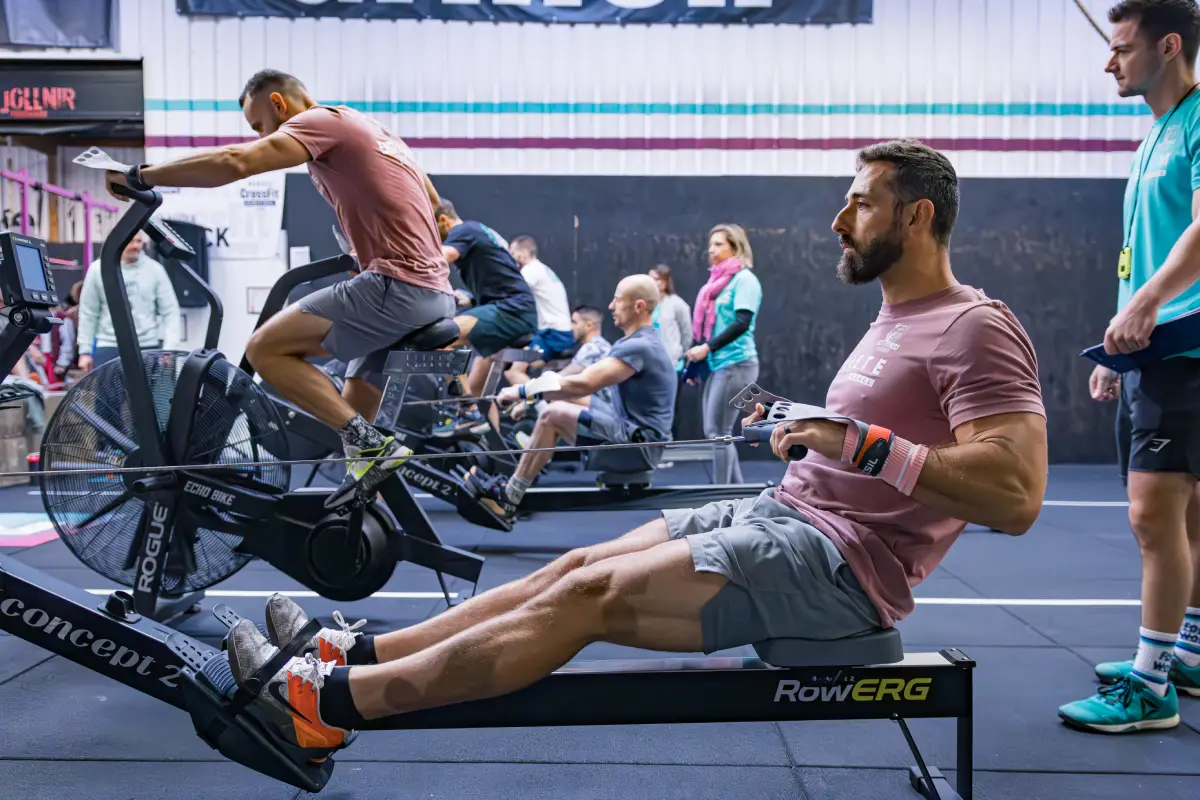
Two sports. Two formats. One question that thousands of functional fitness athletes ask every year: CrossFit or HYROX? Both are demanding, community-driven, and growing fast — but they attract different athletes for different reasons, and competing in one does not automatically prepare you for the other.
Compete Zone is the only event directory that indexes both CrossFit and HYROX competitions worldwide, so we've had a front-row seat to how athletes navigate between (and within) both sports. Here is the honest comparison.
What Is a CrossFit Competition?
A CrossFit competition is a multi-workout event where athletes complete a series of workouts (WODs — Workouts of the Day) over one or two days. The defining characteristic is variability: workouts are not announced in advance (or announced with little lead time), and they can include any combination of barbell movements, gymnastics, cardio, and odd-object exercises.
A typical throwdown might include: a heavy clean complex, a gymnastics-heavy chipper, a short sprint piece, and a team relay. Athletes are scored on each workout, and rankings are combined across all WODs to determine the overall winner.
CrossFit competitions are almost always held at CrossFit affiliates or adapted sports venues, and the atmosphere — boxes pushed against the walls, judges on the floor, loud music — is part of the culture.
What Is a HYROX Race?
HYROX is a structured fitness race with a fixed, standardized format. Every HYROX race worldwide follows the same structure: 8 × 1 km runs, each immediately followed by one of eight functional exercise stations. In order:
- Station 1: 1 km SkiErg
- Station 2: 50 m Sled Push
- Station 3: 50 m Sled Pull
- Station 4: 80 m Burpee Broad Jump
- Station 5: 1 km Rowing
- Station 6: 200 m Farmers Carry
- Station 7: 100 m Sandbag Lunges
- Station 8: 75–100 Wall Balls (depending on category)
Total distance is approximately 8 km of running plus the eight stations. Completion time for a competitive finish ranges from 55 minutes (elite) to 90+ minutes (standard). Because the format is always the same, athletes can train specifically for HYROX and track their improvement race over race.
Side-by-Side Comparison
| Feature | CrossFit | HYROX |
|---|---|---|
| Format | Multiple unknown WODs over 1–2 days | Fixed: 8 km run + 8 functional stations |
| Movements | Barbell, gymnastics, monostructural, odd objects | Rowing, sled push/pull, burpees, wall balls, lunges, KB, sandbag, farmers carry |
| Duration | 1–2 days, 3–6 WODs | Single effort, ~60–90 min |
| Predictability | Unknown workouts | Same format every race |
| Entry level | Scaled / Foundations divisions | Pro, Elite, Standard, Doubles, Relay |
| Cost | €30–150 (throwdown) | €80–200 (HYROX race entry) |
| Venue | CrossFit affiliates, sports halls | Large arenas, dedicated HYROX venues |
| Calendar | 950+ events, year-round | Official season Oct–June, 70+ races globally |
Who Should Start with CrossFit Competition?
CrossFit competition is the better fit if:
- You already train at a CrossFit affiliate and want to test your skills in a competitive setting
- You enjoy the variety and unpredictability of the unknown workout format
- You want to compete as part of a team (most throwdowns have team categories)
- You are comfortable with barbell cycling, gymnastics movements (pull-ups, toes-to-bar), and high-intensity intervals
- You want to find events very close to home — with 950+ CrossFit events in 46 countries, there is almost certainly a throwdown within a few hours of wherever you train
Who Should Start with HYROX?
HYROX is the better entry point if:
- You have a running or endurance background and want to add a functional strength layer
- You prefer knowing exactly what you are training for — the same eight stations, every race
- You are new to functional fitness and want a structured, accessible entry point
- You want the large-venue, stadium-style race experience
- You want to track consistent improvement across a standardized format
Can You Do Both?
Yes — and many athletes do. CrossFit training builds the strength, gymnastics capacity, and metabolic conditioning that makes HYROX's functional stations easier. HYROX training builds the sustained aerobic pace and movement efficiency that helps CrossFit athletes in longer workouts.
A growing number of athletes compete in both sports in the same season: CrossFit throwdowns in spring, HYROX races in autumn and winter. The two calendars complement each other well, and the skills transfer in both directions.
Compete Zone is the only directory that lets you browse both sports in one place — so if you want to plan a mixed-sport competition season, you can do it without switching between tools.